

Leadership and Creative Innovation:What I Learned From a 25-Year, 28,000-Person Global Mural Project

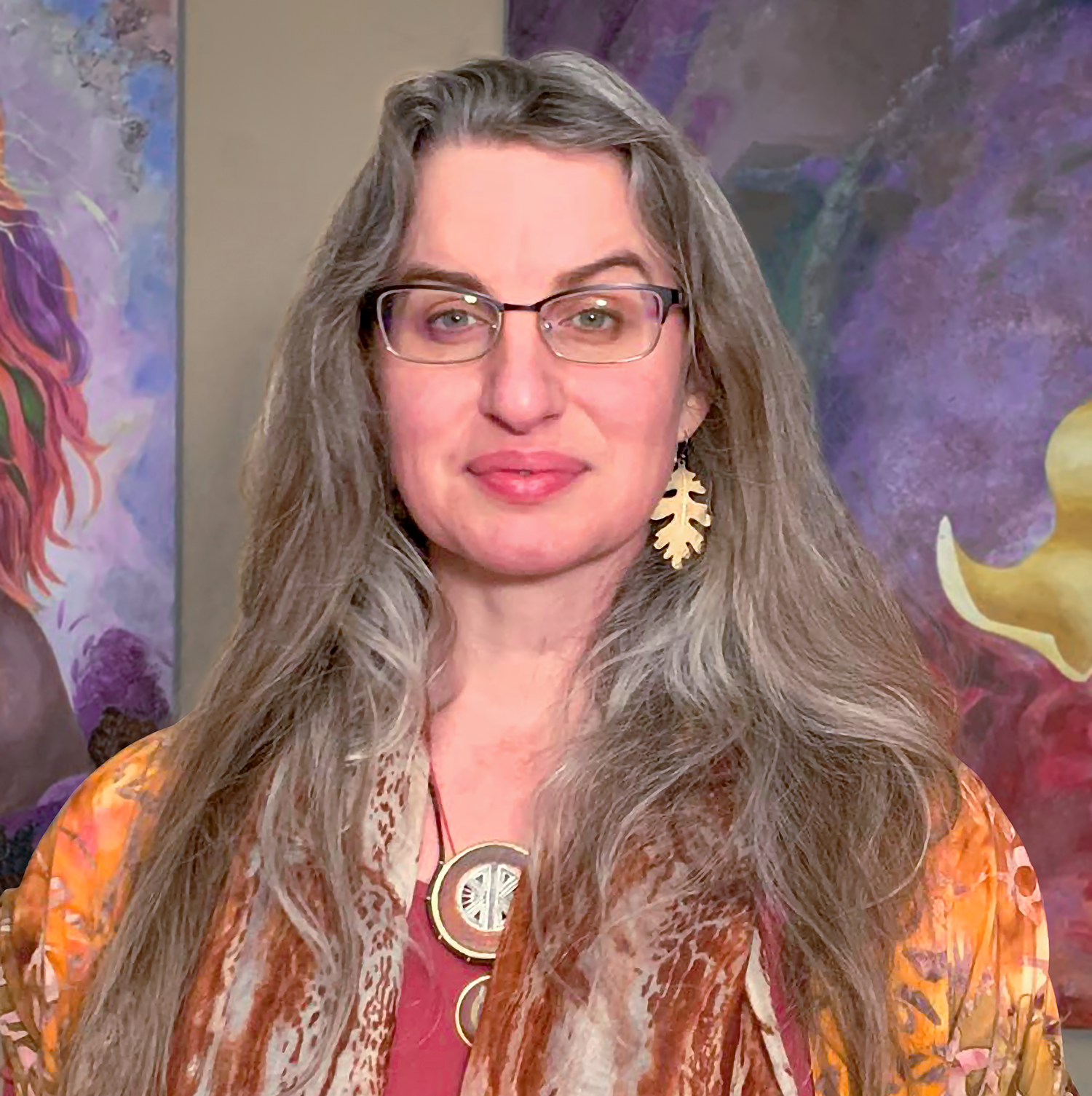
Leadership is not a title. Leadership is a Sacred Assignment. Leadership is a response to something that needs to be done without being asked (Meg Wheatley). Leadership is creating an energetic field where everyone can be their best. These are foundational ideas I’ve used to create “The Singing Tree Mural Project” – a 25-year-old leadership program that has served 28,000 people from 65 countries. It was inspired in 1999 by an 8-year-old girl who asked, “What if the whole world made a painting together?” Since then, 159 murals have been co-created that distill a community’s shared vision of success for difficult challenges, help heal heartbreak and deepen connection across divisions. This article will explore the leadership principles of Gratitude, Unfolding and Faith that have emerged as the operating framework developed through this real-world lab.
Gratitude for the miracle of Life and Love in the Universe, for the bountiful earth and the community that holds us
Trust in the creative process as it unfolds and reveals surprises and solutions
Faith in the unique imagination and needed contribution of each person
The Singing Tree Mural process is the flagship program of Unity Through Creativity Foundation, a non-profit that uses the Quaker practice of seeking that of God in everyone. This approach consistently unleashes the gifts of all individuals to help address challenges and innovate community solutions together. The participants create murals or other collaborative art forms that bring awareness to important issues, allow communal grieving and serve to accelerate trust, often sparking innovation.
For instance, in 2019, 350 students at Ukiah High School in Ukiah, California, made The Singing Tree of Climate Solutions. Afterwards, the students sought to cover their school’s parking lot with solar panels. Their image was honored by being flown as a flag at Rockefeller Center in New York City for Earth Month in April, 2020 expressing the students concern for the warming of the planet.

The title of the Singing Tree Mural Project comes from Kate Seredy’s book called The Singing Tree. She shared a story from her father’s experience as a Hungarian soldier in World War I:
One night, our battalion crawled all night long on our bellies in the mud to escape the Russian enemy. Everything had been destroyed by war. There was no living thing. No bush, no building, and no living thing was still standing. As the night wore on, we became more and more terrified. When the dawn came, we looked upon a hill and saw that one tree had survived. Birds from hundreds of miles around, who are not normally together, filled the tree, singing a song that had never been heard before.
The Earth is the Singing Tree of the Galaxy. For billions of miles, there is no life that we know
of. We can choose to destroy our precious planet and each other, or we can create Beauty that
has never been seen before. That is the job of the Singing Tree Mural Project – Peace
leadership through art inspired by nature.
I’d like to share three examples of leadership by Singing Tree Facilitators - one guided by
Gratitude, one guided by Unfolding and one guided by Faith.

Camp Fire Five-Year Memorial
Led by “Gratitude” for the Land and Community
During the week of the five-year memorial of the Camp Fire in northern California, which is the deadliest fire in U.S. history, the community gathered at the site with music, food, and reflection. Singing Tree Mural Facilitator Bobbie Rae Jones, who lives in nearby Chico, California, led a chalk mandala drawing process to distill the wisdom that this suffering and loss had brought to Paradise, California – a place where 85 people died and 50,000 structures were lost. She engaged with the community weeks before the chalk hit the concrete, asking the following questions:
So….it’s five years. Our lives are changed, reflecting on all since the incident, time has passed, and the space around us looks different, what is the feeling now? What is a symbol that is reflective of the container of our current experience? What passage is this? What wisdom did this suffering bring us? How can we transform our trauma into purpose that is rooted in gratitude for what we have now? What image do the people, the land, and the animals need?
Bobbie Rae organized the responses of those affected by the fire into an image that the community helped to draw on the concrete. The result was an experience of grieving, solace, comfort, connection and transformation and beauty.
"I'm reminded of the oak and the acorn and the struggle to become something strong and beautiful through adversity." - Rebekah Dodson, Camp Fire Survivor, Paradise, California
"Ya know, it takes a fire to open a pine cone to seed. It’s nature regenerating itself. A simple program of biology…universal concept…its not the environment thats suffering, we are. Ultimately it is a blessing of transformation, to acknowledge, grieve, and move on.” - Mike Wofchuch, Camp Fire Survivor, Paradise California

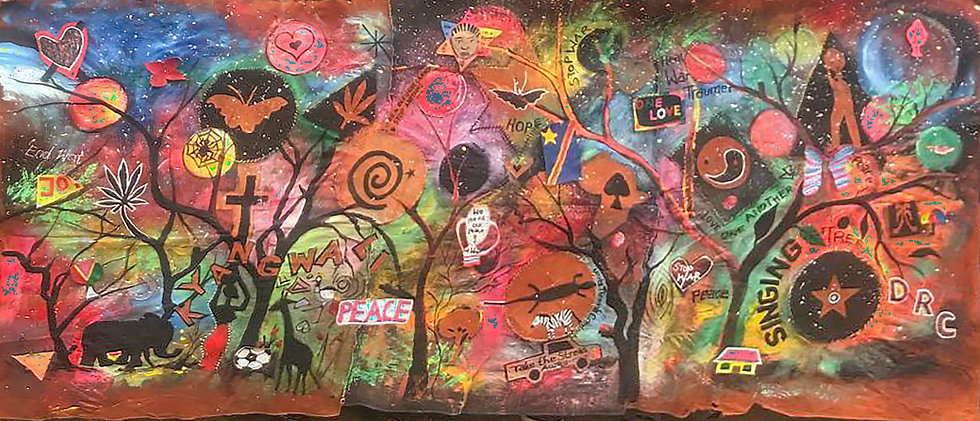
The Singing Tree of Healing the Trauma of War
Led by “Unfolding” of the Creative Process
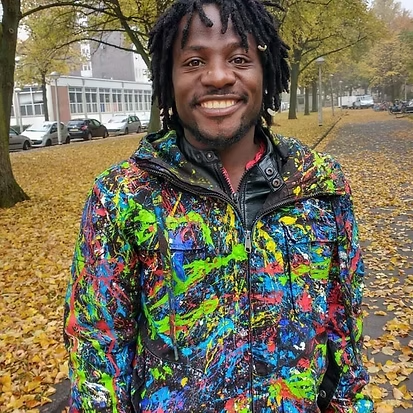
Emma Kavuma, Kampala, Uganda
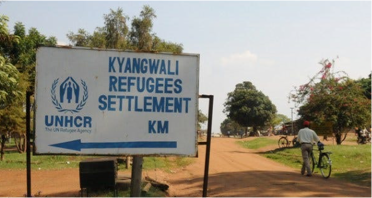
The Kyangwali Refugee camp is all too familiar with leaving one's homeland because of war. 95% of the refugees who live in the UN's settlement in northern Uganda have come from the Congo. The trauma of war has stayed with them for decades and the need for healing is intense. The Singing Tree process is a collective way for feelings to be expressed and stories to be shared - a necessary step in healing.
Singing Tree Facilitator Emma Kavuma created a safe space for 22 participants from 11 of the 19 villages that make up the refugee camp. As with all Singing Tree murals, no one knew what image would emerge. Emma trusted that the creative process would do its work, producing a powerful collective statement. He made the following observations:
We proved that 11 different villages can speak 11 different dialects but share one single heart. I saw that recovery does not happen in isolation; we healed by witnessing and validating each other's pain. By sharing paintbrushes, we shared stories, shifting our perspectives from individual survival to collective care. We deliberately chose vibrant colors to show that our futures are bright, despite the darkness of our pasts. Participants realized they are no longer just passive victims of war, but active creators of their own narratives. Many participants arrived carrying the silent, heavy isolation that trauma forces upon a soul. As the layers of the Singing Tree design came together, those walls crumbled. The workshop provided a safe, non-verbal outlet for grief that words simply could not express. The physical act of mixing paint, blending colors, and working on a shared vision forced everyone into the present moment. I watched hands that once trembled with anxiety become steady, confident, and purposeful.
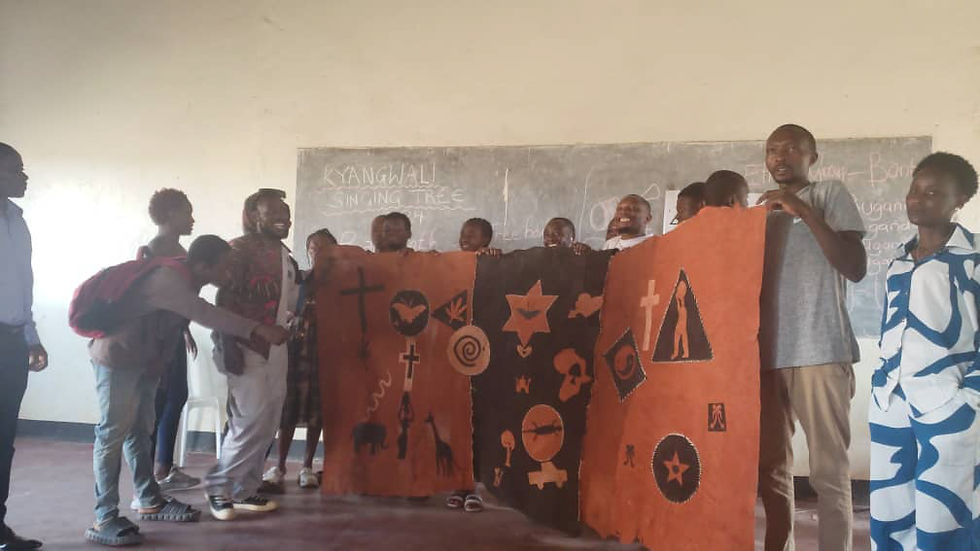
This mural is a physical testament to their survival. For the 22 participants, seeing a piece of their village woven into a grander, beautiful ecosystem has restored a sense of pride and ownership. They did not just paint a tree; they planted roots of peace in Kyangwali.
Emma embraced the “Unfolding” of the alchemy that happens when people share their stories, their images, their trauma, their imagination and their vision of the world they want.
The Maple Singing Tree of Imagination in Prison
Led by “Faith” in the Unique Contribution of Each Individual
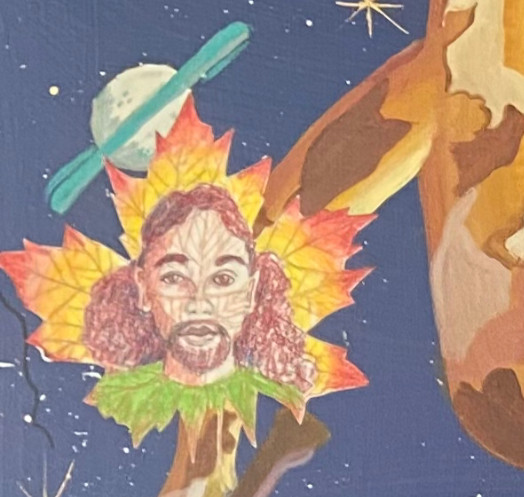

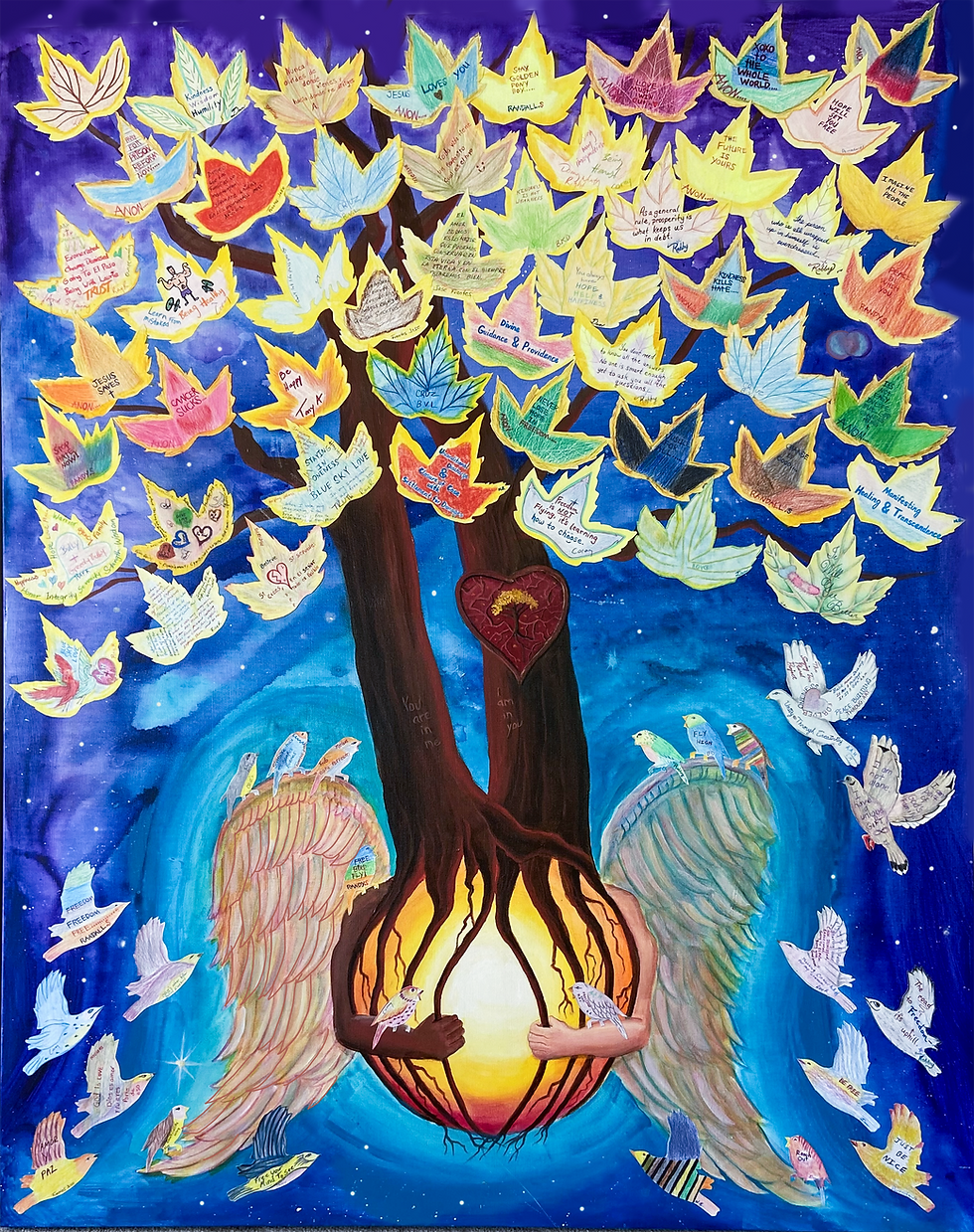
Ten men from different walks of life, ranging in age from their early twenties to late sixties, came together to co-create this Singing Tree mural in a state prison in Colorado. The project was facilitated by their fellow inmate Ray Ramcharan, my godson and former high school art student in Rappahannock County, Virginia in the late 90’s. Making the painting was a collaboration between the outside world and the confines of the prison walls. Using The Singing Tree Facilitator’s Guide to explain the process and recruit participants, Ray met the challenge of getting his peers to sit down all at once for several days, coordinating schedules and moving between pods, which is not normally permitted. The goal of the project was to support the freeing power of imagination for people in this highly restricted environment. As everyone worked on a common goal, unfamiliar men became acquainted. They laughed and listened to each other. Conversations took place and a sense of community with deepened respect for one another developed. Trust increased and new friendships were created. Through witnessing the effort, risk and uniqueness of each participant, the group helped each other rise above the limiting and harsh circumstances of prison. By being part of something bigger and more beautiful than anything they experienced prior, the inmates offer this gift to the outside world.
"I learned that leadership depends on someone believing in you, that faith is contagious. Most importantly, I learned to have faith in my imagination as a true source of freedom and faith in the possibility of connection in a place built for mistrust and isolation." - Ray Ramcharan
In conclusion, practicing leadership with the principles of Gratitude, Unfolding and Faith is the opposite of practicing leadership that uses Punishment, Control and Fear. The Singing Tree Mural Project demonstrates the joyous, explosive and healing results of embracing a creative, collaborative approach to leadership.


Comments